
Why things stay wet at the coast
Air along the coast from Kidds Beach to Port Alfred is damp most of the year. On a lot of days the humidity in East London sits above 75 percent, and a wet wall or floor can only dry as fast as the air around it can take up the water. Open windows do not help much when the air coming in is just as wet. That is why a new screed in Beacon Bay can still feel cold and damp weeks after it was laid, and why a lounge carpet that got soaked in a storm starts to smell before it dries.
An industrial dehumidifier fixes the air side of the problem. It draws room air over a cold coil, the moisture condenses into water and runs away down a hose, and drier, slightly warmer air goes back into the room. That dry air then pulls more moisture out of the plaster, the screed, the skirting and the furniture. Doors and windows stay closed and the machine keeps working day and night until the readings come down.
The machines we hire out
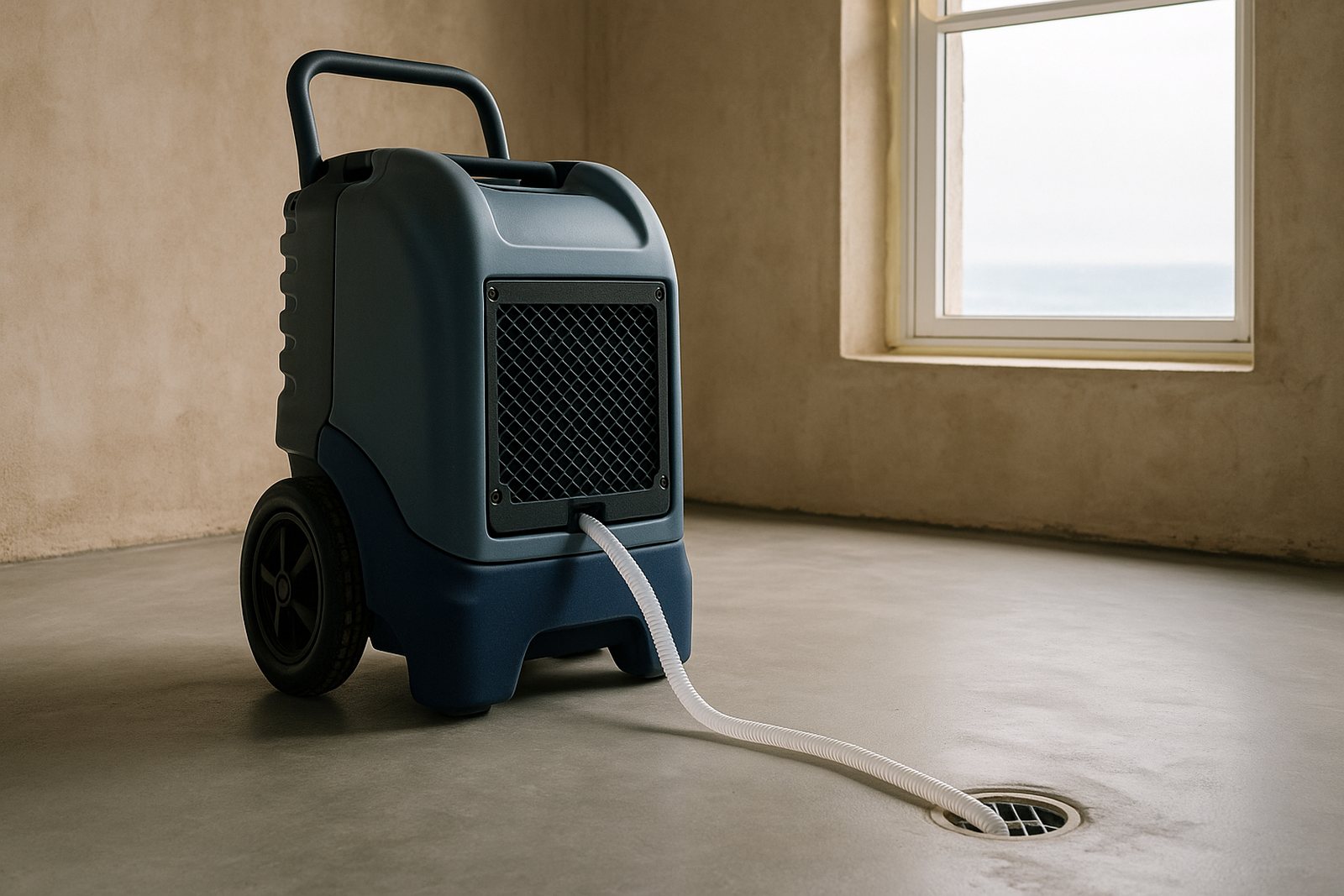
Our dehumidifiers are commercial refrigerant units built for building sites and restoration work, not the small plastic ones sold for bedrooms. They have big wheels and a pull handle so one person can roll them through a house, and the housing takes knocks in a bakkie.
- Compact unit for one or two rooms, rated at roughly 30 to 50 litres a day, drawing about 500 to 700 W
- Large unit for open-plan areas, halls and shops, rated at roughly 70 to 90 litres a day, drawing about 1 to 1.3 kW
- Standard 220 V plug, so it runs from a normal wall socket
- 5 m drain hose for continuous running into a floor drain, bath, shower or sink
- Auto defrost for cold rooms and auto restart after a power interruption
- Built-in humidistat and hour meter, so you can see how long it has been running
The litre ratings are measured in warm, very humid test conditions. In a real room at 18 to 22 degrees the machine pulls out less than that each day, which is normal. On the first day after a flood you will often empty a lot of water, and the amount drops off as the room dries out.
Jobs we hire it for
Most of our dehumidifier hires around East London, Gonubie and Qonce fall into a few kinds of job.
New screeds before flooring. A standard sand and cement screed can take six weeks or more to dry on its own in coastal air. Vinyl, laminate and timber floors fail if they go down on a screed that is still wet, and the flooring fitter will usually test before laying. Running a dehumidifier in the closed room shortens that wait a lot, but always test before you lay.
Plaster before paint. Fresh plaster that is painted too early blisters and stains. The machine dries the walls evenly, which is handy when the painter is booked and the weather is not helping.
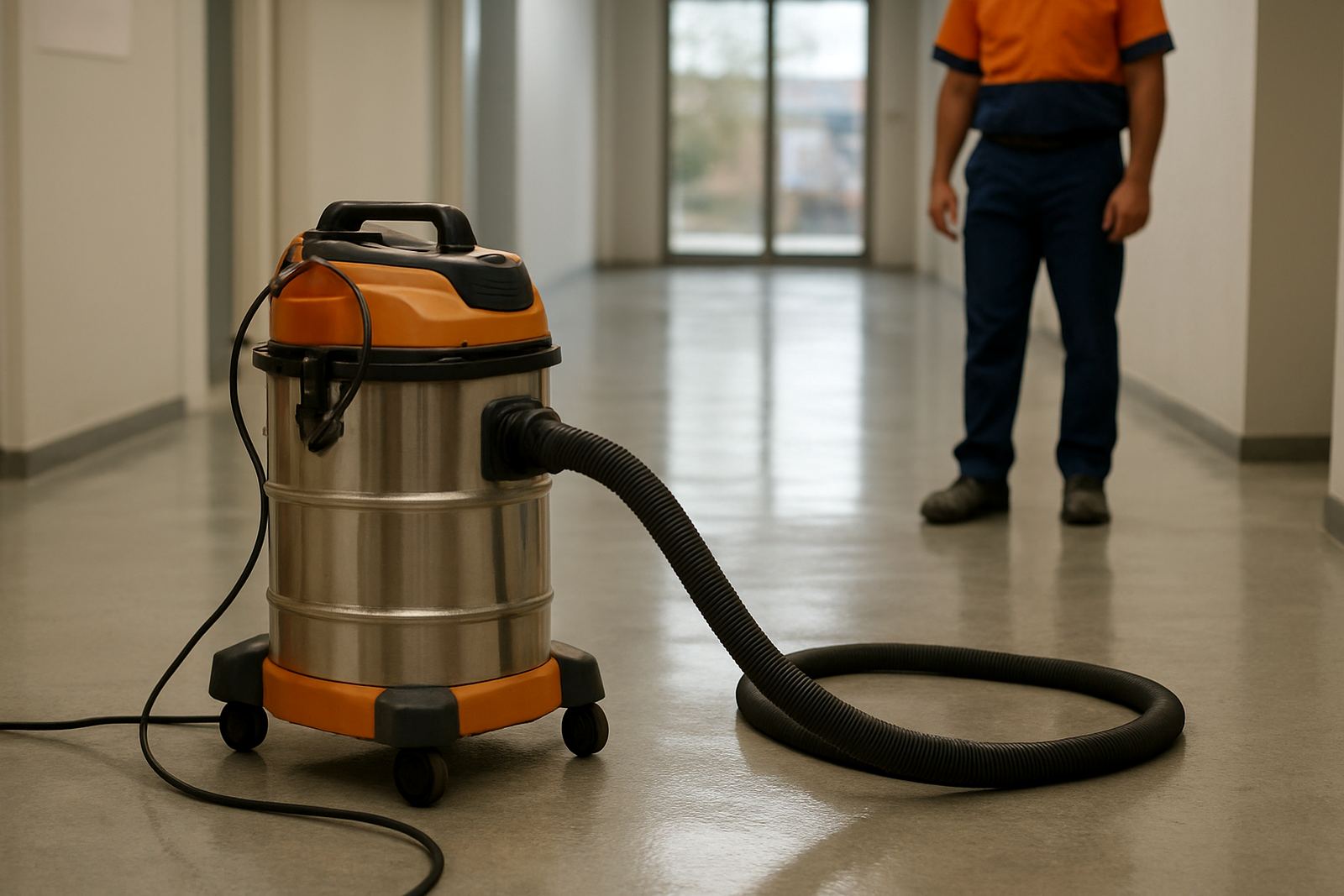
Leaks, burst geysers and storm water. After the standing water is out with a wet vacuum, the dehumidifier does the slow part: drying the screed under the carpet, the bottom of the walls and the cupboard bases before mould gets going. Our note on recovering a site after rain and the storm clean-up page cover the first steps.
Damp holiday homes and storage. Guesthouses and holiday homes that stand closed through winter get musty quickly. A week of drying before the season opens takes the smell out of linen cupboards and curtains.
Setting it up so it works
Where you put the machine matters as much as which size you pick. We talk this through when we deliver, and these are the points that make the biggest difference.
- Close the roomShut windows and doors so the machine dries the room, not the street outside. Tape plastic over open doorways in a renovation.
- Run the hoseLead the drain hose to a floor drain, shower or bath so the unit never stops for a full tank.
- Lift and open upLift wet carpets and underlay, pull skirting where water got behind it, and open cupboard doors.
- Keep it centralStand the machine in the middle of the room, at least 300 mm from walls, with the air outlet facing the wettest area.
Check the water and the hour meter once a day. If the room still smells damp after a few days, or the wall at skirting height is still cold to the touch, keep it running. For bigger losses on insured homes, the assessor or restoration company will normally want moisture readings, and we can leave the machine in place for as long as they need.
Power cuts, delivery and hire terms
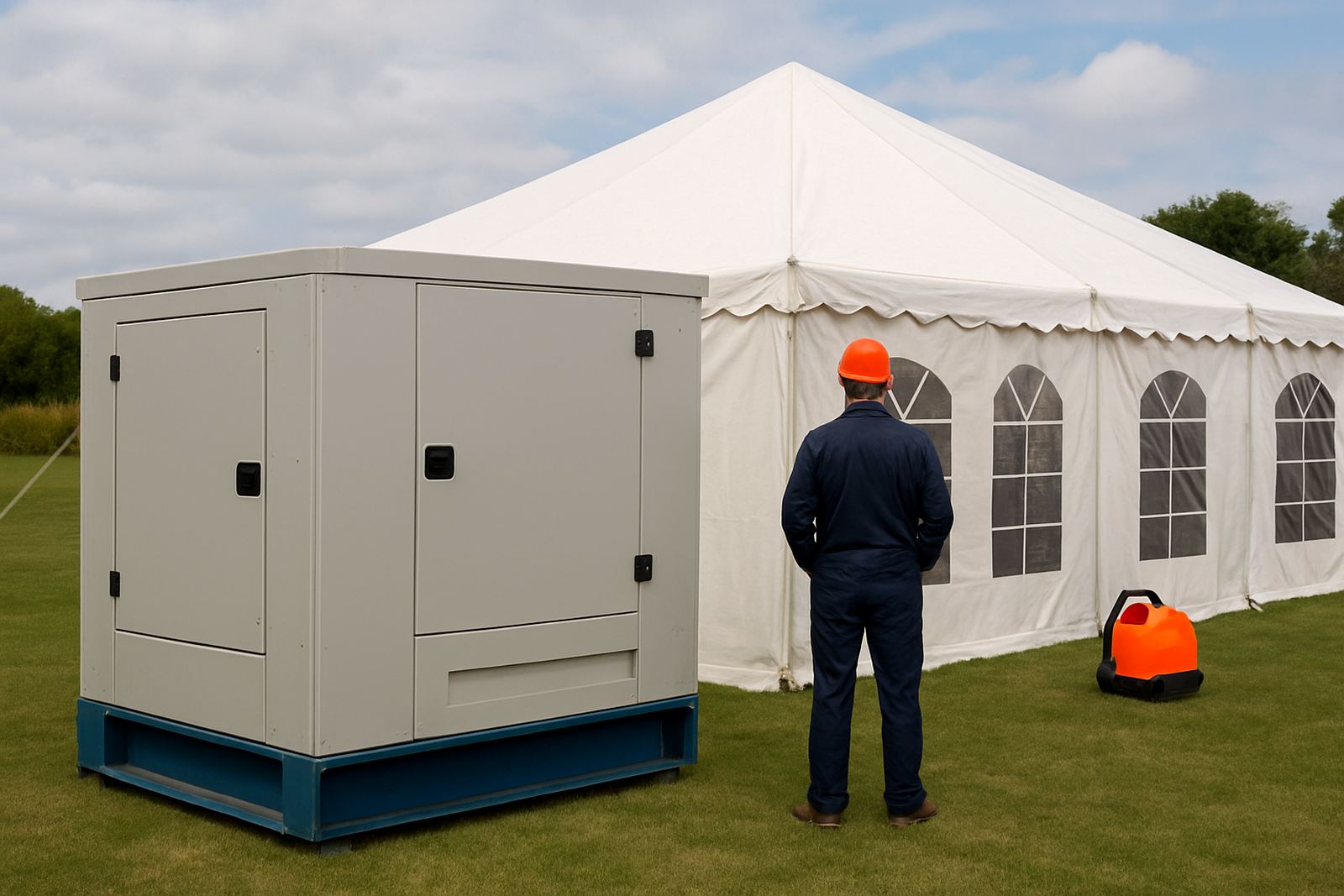
When the power goes off the dehumidifier stops, and when it comes back the machine restarts on its own with the same settings. On long cuts a compact unit runs comfortably from a portable generator, and on guesthouse jobs where noise matters we pair it with a silent generator. Keep the generator outside and run a proper extension lead in.
We hire by the day or by the week, with weekly hire the better value for screeds and flood drying. Delivery and collection are arranged from our Beacon Bay yard across East London, Gonubie, Kidds Beach, Qonce and Port Alfred, and we can swap a compact unit for a large one mid-hire if the job turns out bigger than it looked. Prices depend on the unit, the number of machines and the hire length, so send us the room sizes and what got wet and we will quote.
Key facts
| Equipment | Commercial refrigerant dehumidifier on wheels |
|---|---|
| Sizes | Compact about 30 to 50 L a day, large about 70 to 90 L a day (rated) |
| Power supply | 220 V single phase, about 500 W to 1.3 kW depending on unit |
| Water removal | 5 m continuous drain hose or tank with auto shut-off |
| Features | Auto restart after a power interruption, auto defrost, humidistat, hour meter |
| Typical jobs | New screeds and plaster, leaks and storm damage, damp holiday homes and storage |
| Hire terms | Daily or weekly, extendable, quoted per job |
| Service area | East London, Beacon Bay, Gonubie, Kidds Beach, Qonce and Port Alfred |