Start With the Water You Need To Move
For most site dewatering jobs, the first question is not the pump make or whether it looks powerful enough. It is how much water must move, how quickly, and where it has to go. A small trench after rain on a Beacon Bay build is very different from a flooded basement in Qonce or a sump that keeps filling on a coastal site in Kidds Beach.
Think in three parts. Flow tells you how much water the pump shifts over time. Head tells you how high or far the pump must push that water. Hose length affects both, because every extra metre adds resistance. If any one of those is off, the job slows down and the pump may strain, especially where silty water clogs the line.
Flow: How Fast the Job Must Clear
Flow is usually given in litres per minute or litres per hour. For clear water in a shallow pit, a modest pump may be fine. For a site with heavy inflow after a coastal downpour, you need a higher flow rate so the water level drops quicker than it rises.
A practical way to judge flow is to ask how long the job can afford to take. If your crew needs the trench dry before shuttering goes in, slow flow can delay the whole programme. If you are keeping a floor area dry for a weekend event near Gonubie and the rain starts, you want speed more than anything.
- Small puddles or shallow sumps: lower flow is often enough
- Trenches and foundations: medium flow usually suits most building work
- Flooded areas or fast inflow: choose higher flow with good solids handling if needed
Head: The Vertical Lift and Pressure Loss
Head is the height the pump must lift the water, measured in metres. If your discharge point is only a short distance away and slightly higher than the pit, the head is low. If you need to pump up an embankment, over scaffolding, or into a roadside drain that sits well above the excavation, the head rises fast.
Many site pumps can move plenty of water at low head, then slow down sharply once the lift gets taller. That is why a pump that looks suitable on paper can disappoint on site. In East London, we often see this where water must travel from a low-lying area to a higher safe discharge point and the hose run is long. The pump may still work, but not at the flow you expected.
A good rule is simple: the more height and hose you add, the more pump capacity you need. If you are unsure, rather over-spec slightly than under-spec. A pump running near its limit is more likely to lose performance, and a blocked line makes things worse quick.
Hose Length Can Quietly Change Everything
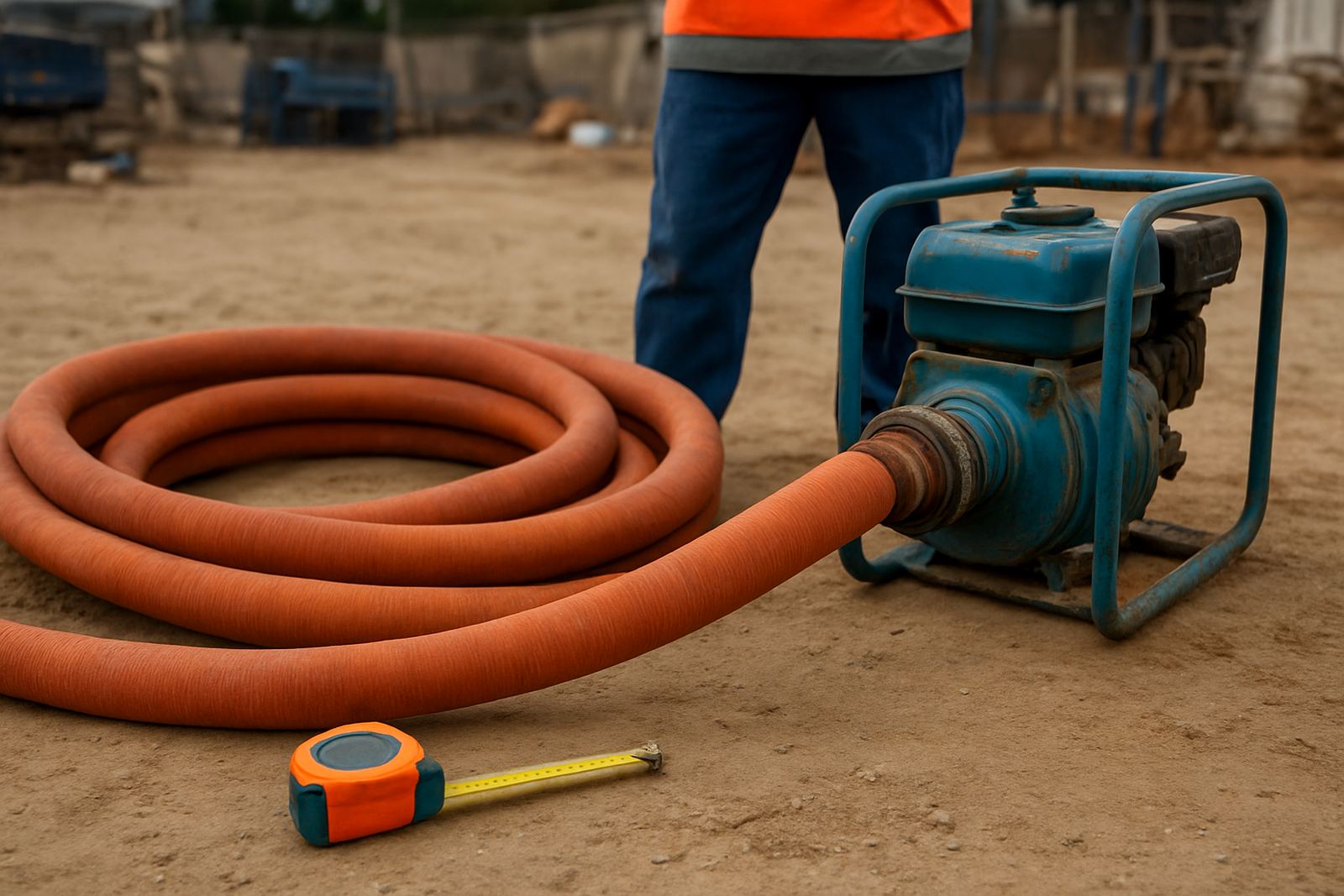
Hose length is easy to ignore when you are ordering, yet it can be the thing that causes poor performance. Long hoses create friction, especially with bends, joins and uneven ground. Water also moves better through wider hose than through a narrow one, so the same pump can behave very differently on two sites.
On a muddy coastal site, keep the hose route as straight as possible and avoid kinks. Secure it so it does not whip or flatten under vehicle traffic. If the discharge point is far from the pump, ask for a setup that matches the actual distance, not just the straight-line estimate on paper.
- Short, straight runs usually give better output
- Long runs need more pump capacity and proper hose diameter
- Too many bends can cut performance even where the head seems low
Match the Pump to the Water Type
Not every pump suits every job. Clean water, dirty water and water with small solids each need different thinking. On building sites, the water often carries sand, silt and bits of debris from the excavation. Around event sites, you may be dealing with surface water after rain rather than thick slurry.
If the water is fairly clean, a standard dewatering pump may be enough. If there is grit, mud or a risk of small solids, you need a pump that can cope with it without clogging. For very shallow areas, a low-suction setup can help get the last bit out, though the site surface must suit that method.
In coastal areas, also think about salt air and humid conditions. Equipment left wet for too long can give trouble, so proper positioning and after-use cleaning matters as much as size selection.
A Local Example from Beacon Bay To Port Alfred
Picture a foundation pit in Beacon Bay after two days of rain. The water is not deep, but it keeps seeping in from one side. The discharge point is across the site and slightly uphill. In that case, a small pump with a long narrow hose may run all day and still leave the pit soft.
Now compare that with a flooded service trench in Port Alfred where the water level needs dropping before a repair crew can get in. There the pump must move water quickly and keep doing so as fresh water comes in. The better choice is the pump that gives enough flow at the required head with hose that suits the distance. That is the difference between finishing before the next tide or losing another shift.
A Practical Checklist Before You Hire
Before you book a pump, have these details ready. It saves time and helps the right unit get loaded first time.
- How deep is the water and how fast is it coming in?
- How high must the water be lifted?
- How far is the discharge point from the pump?
- Will the water carry sand, mud or small solids?
- Is power available on site, or do you need a fuel-driven option?
- Do you need weekend cover or an emergency callout?
If you are working in East London, Gonubie, Kidds Beach, Qonce or Port Alfred, it also helps to say whether the site is easy to access with a trailer or whether delivery and setup are needed. That makes the handover smoother and reduces delays on the day. A short pre-hire briefing can save a lot of trouble later.